|
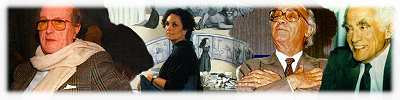
 Almada Negreiros
José de Almada Negreiros was born in Săo Tomé e Princípe,
Cape Verde Islands, in 1893 and died in 1970. This artist was a
man of many talents and diverse artistic expressions. Painter, writer,
dramatist, poet, ceramist, all of these fields bear his indelible
mark. His passion for creativity was recognized by being elected
in 1966 as an Honorary Member of the National Academy of Fine Arts.
He was later further recognized by being awarded the "Grand
Order of Santiago e Espada" in 1967. His creative work can
be seen in many public places and in various mediums. He remains
an artist who has left his mark on 20th Century Portugal.
Carlos Reis
Born in 1863 in Torres Novas, and died in 1940 in Coimbra.
A painter of portraits and figurative subjects. He quickly achieved
fame after studying in Lisbon and then after in Paris.
He was awarded many prizes in his lifetime and achieved a position
of influence in the world of art in Lisbon. He was the moving
force behind the establishment of the National Society of Fine Arts,
thus giving artists a dignified home in which to exhibit their latest
works. He was also instrumental in the creation of the "Ar
Livre" movement in Portugal. This was a school which thought
that painting should be conducted in the open, using rural subjects.
Columbano Bordalo Pinheiro
Born in 1857 in Almada, and died in 1929, he represents the
leader of the of the Naturalism school of art in Portugal. Born
into and aristocratic and artistically inclined family, he and his
ceramist brother became outstanding artists within their own lifetime.
His productivity was immense and a large collection of his works
is held by the Museum of Modern Art in Lisbon.
Jorge Vieira
Jorge Ricardo da Conceiçăo Vieira was born in Estremoz
in the Alentejo in 1934, and died in 1998. After studying in Lisbon
he moved to London to attend the Slade School of Art on a
course directed by the English sculptors, Reg Butler and
Henry Moore. Although he extended himself in his personal
interpretations, both these artists had a strong influence on his
works. He was diverse in his medium and used metal, clay, bronze
and stone. Not particularly know outside of Portugal his work is
highly respected within its borders and many public monuments bear
his name. In 1993 his workshop and home in Beja was
converted into a permanent museum of his works.
José Malhoa
José Vital Branco Malhoa was born in 1855 in Caldas da
Rainha and died in 1933. His background was humble and he had
to fight hard to achieve recognition during his life. He was of
a character that made few friends and it was his quality as a
painter that carried him through his adversities. There is a
museum in his town of birth and carries the artist’s name
and maintains an excellent collection of his works.
Júlio Pomar
In 1926 Júlio Artur da Silva Pomar was born in Lisbon.
He has been a leading painter in the esteem of the Portuguese critics
since the 1940s. He was an active founder in 1956 of Gravura,
a graphic workshop run for the benefit of the member artists. He has
exhibited in major countries and won many awards. In 1963 he made his
permanent home in Paris in order to be closer to the centre of
progressive new developments in the world of art.
Josefa de Obidos
Josefa de Ayala y Cabera was born in Seville, Spain,
in about 1630 and died in 1684. Her father being Portuguese brought
her back to Portugal when very young. Having settled in the walled
town of Obidos her father encouraged her to follow in his
profession of painting. Her many works that remain are outstandingly
feminine for their tonal values. Compared to other painters in Portugal
of the same period her style is distinctive even when she depicts
religious subjects typical of that time.
Mário Cesariny
Born in Lisbon in 1923 and died in Lisbon in November, 2006.
His full name was Mário Cesariny de Vasconcelos. He was mainly
known as a writer and a painter but his artistic activities also
covered poetry and as an art critic. He, along with Alexander
O’Neill and António Domingues, founded in 1947 the
Lisbon Surrealist Group. His creative ability in art remained loyal
to the interpretation of the Paris movement as brought back from
Paris by the painters António da Costa and António
Pedro. His extensive writing is said to have revealed influences
of both Brecht and Pirandello. His paintings and
drawings can be found in all the major collections in Portugal.
Paula Rego
Paula Figueiroa Rego was born in 1935 in Lisbon. On
her decision to make her career in Art she departed in 1954 to
attend the Slade School of Art in London. She married an
Englishman and made her permanent home in that country. However,
her roots have constantly brought her back to exhibit in Portugal
where she is highly respected. Her name today is renowned in the
art world and she has been placed amongst the four best living
painters within England today. Exhibitions of her figurative style
of painting are constantly being held in leading galleries.
Soares dos Reis
This important sculptor António Soares dos Reis was born
in 1847 in Vila Nova da Gaia, just across the river
from Porto. He committing suicide in 1889. Coming from a
humble background his potential as a sculptor was happily recognized
by a neighbour and art teacher who arranged for him to receive art
lessons at the early age of 14. He quickly gained awards and moved
to Paris in 1867 for three years study. Shortly after, he
spent a period in Rome before returning to Porto in 1872.
He was received immediately with a teaching position at the Porto
Academy of Art at the age of only 25. Here he stayed until his death
only 17 years later. His outstanding collection of work can be seen
in the impressive museum in Porto that is named after the
artist.
Souza-Cardoso
Amadeu de Souza-Cardoso was born in Manhufe in 1887
in the north of Portugal, and died at an early age in 1918. This
artist was the main influence in introducing into Portugal modern
schools of art that were already established in the rest of Europe
at that time. In 1906 he moved to study in Paris and was
influenced by the "Cubist Movement" having made contact
with such artists as Modigliani, Picasso and
Braque. Souza-Cardoso appears as one of the principal
names on the poster advertising the 1913 "Amoury Art Show"
in the U.S.A. Here at this Show he was exhibited in Boston,
Chicago and New York, alongside his famous contemporaries
from Paris. This was the first official introduction of what is
commonly known as Modern Art in northern America. His remaining
works are sadly too few in number and those that have survived are
prized possessions of Portuguese collectors. They show his
considerable talent that was tragically robbed from the art scene
by his early death.
Vieira da Silva
Maria Helena Vieira da Silva was born in Lisbon in
1908. She commenced her studies in Lisbon. In 1928 she moved to
Paris to frequent the Academy La Grande Chaumiére and also
initially the studio of the sculptor Bourdelle. In 1929
she turned to painting and was to meet the famous painter
Arpad Szénes whom she married in 1924. It was only in 1933
that the artist held her first individual exhibition that was in
Paris. To her lasting regret, due to the regulations by
this act she forfeited her Portuguese nationality. This was only
returned to her much later in life and caused her to live outside
Portugal. Firstly in Paris, then Brazil before returning
to Paris. Her talent and unique style in painting took her
to the very top of the ladder in world acclaim. In 1956 she was
given French citizenship but after the Portuguese Revolution of
1974 she returned to Portugal to receive a warm and official
welcome. In 1990, two years before her death, she had the pleasure
of attended the inaugural meeting of the "Szénes-Vieira
da Silva Foundation". The building in Lisbon that
houses the sizeable collection of both hers and her late husbands
work was opened in 1993.
(Detailed information of
most artists can be found in the reference book names
"Portuguese 20th Century Artists" by Michael Tannock
published by Phillimore Press.)
| 


